
Why 'We Buy Houses' Signs Aren't Always Your Best Friend
What Is a Fast Cash Home Sale — and Is It Right for You?
A fast cash home sale is when you sell your home directly to a buyer who has the funds ready — no mortgage, no bank approval, no waiting. It's faster and simpler than a traditional sale, but it usually comes at a cost.
Here's a quick overview of how it works:
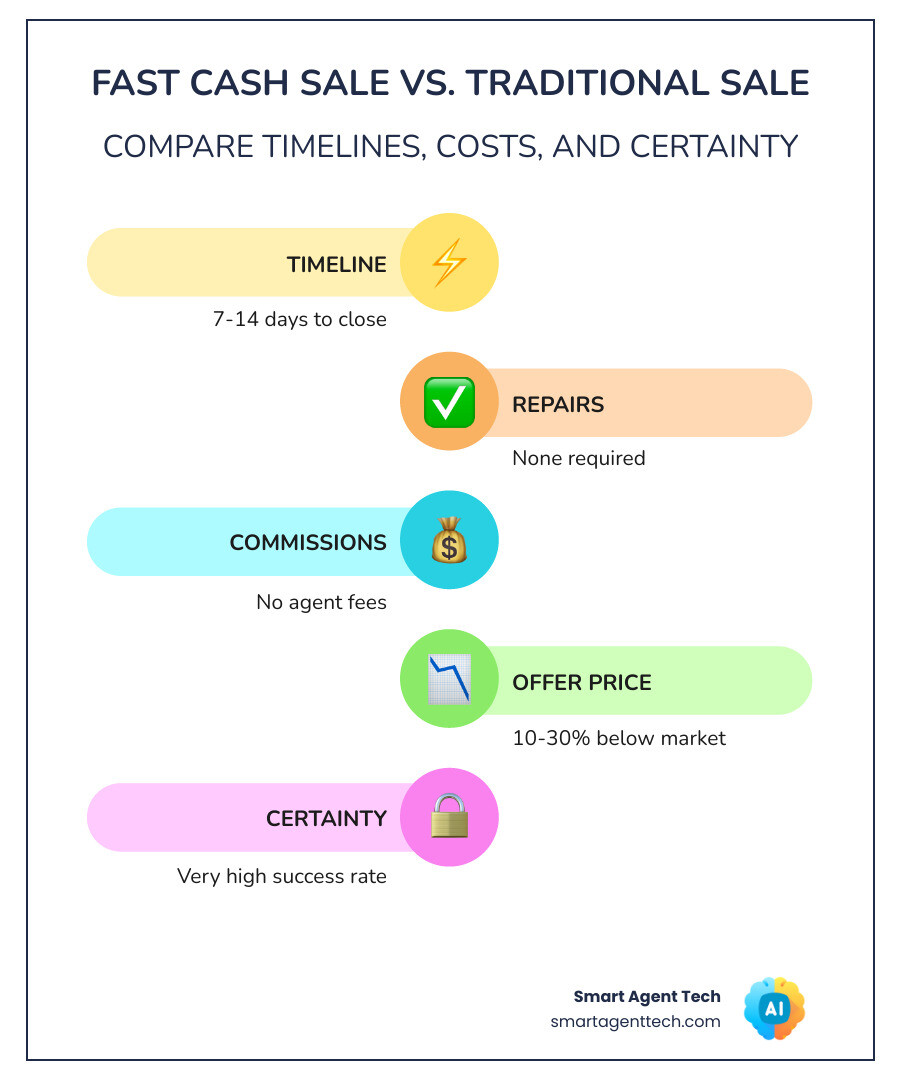
Factor Fast Cash Sale Traditional Sale Closing time 7–14 days 30–60+ days Repairs needed No Usually yes Agent commissions None ~6% Offer price 10–30% below market Closer to full market value Sale certainty Very high ~15% of deals fall through
Cash buyers — including individual investors, institutional iBuyers, and local "We Buy Houses" companies — make up roughly 32% of all home sales today. They offer speed and convenience, but that speed has a price tag attached.
The core trade-off: you get certainty and a fast closing, but you'll likely walk away with less money than if you listed on the open market.
That's not always a bad deal. For homeowners facing foreclosure, divorce, job relocation, or a property in rough shape, the speed can absolutely be worth it. But for everyone else? It pays to know exactly what you're signing up for before you take the first offer that shows up on a yard sign.
I'm Todd Bogert, a real estate website consultant with over a decade of experience helping agents and brokers understand the digital and transactional side of real estate — including the growing world of the fast cash home sale. In this guide, I'll break down who the players are, what the real costs look like, and how to protect yourself from a raw deal.
Understanding the Fast Cash Home Sale: Process and Players
When we talk about a fast cash home sale, we aren't talking about a buyer showing up with a suitcase full of hundred-dollar bills (which, by the way, is actually illegal for real estate closings). Instead, it refers to a transaction where the buyer has liquid funds available and does not require a mortgage or bank financing to complete the purchase.
In markets like Phoenix, Buckeye, and the West Valley, this has become a massive segment of the industry. According to data from the National Association of Realtors, all-cash buyers currently make up 32% of home sales, the highest share since 2014.

There are three main types of players in this space:
Large online home buyers: Companies that use automated valuation tools to generate quick offers, often within 24 hours. They usually focus on homes in good condition and may charge service fees.
Local Investors: Often family-owned companies or independent buyers who purchase homes as-is, renovate them, and resell them for a profit.
Institutional Investors: Large firms that buy homes at scale to hold as long-term rental properties.
The biggest difference between these buyers and a traditional family looking for a home is the "Proof of Funds." A traditional buyer provides a pre-approval letter from a bank, which can still fail if the appraisal is low or the buyer's credit changes. A cash buyer provides a bank statement or a letter from a financial institution proving they have the cash sitting in an account right now.
Feature Cash Buyer Traditional Financed Buyer Appraisal Usually waived Required by lender Financing Contingency None High risk of deal falling through Inspections Often waived or "informational" Usually mandatory for repairs Closing Costs Often paid by the buyer Usually split or paid by seller
The Step-by-Step Fast Cash Home Sale Timeline
If you've ever sold a house the "old way," you know it can feel like a marathon. A fast cash home sale is more like a sprint. Here is how we typically see the process unfold:
Property Valuation: You provide your address and basic details. The buyer looks at "comps" (comparable sales) in Buckeye or Phoenix to see what similar homes are selling for.
Initial Consultation: A quick phone call or a 15-minute walkthrough to verify the home's condition.
The Cash Offer: You receive a firm, written offer. Unlike traditional sales, there is usually very little room for negotiation here.
Inspection Period: If there is an inspection, it's usually brief (often just 1-3 days) to ensure there are no major structural surprises.
Title Search: A title company ensures there are no liens or "clouds" on the title that would prevent a legal sale.
Closing: You sign the papers (often via a mobile notary who comes to you) and the funds are wired to your account.
This entire process can happen in a 7-14 day window. If you want to see exactly how this looks in practice, you can check out How It Works for a deeper breakdown of the streamlined digital process.
The Real Cost of Speed: Discounts and Hidden Risks
We have to be honest: speed isn't free. When a company offers to buy your house in a week without you having to lift a paintbrush, they are taking on a lot of risk. They are responsible for the repairs, the holding costs (taxes, insurance, utilities), and the risk that the market might dip before they can resell.
To cover these risks and ensure a profit, cash buyers typically expect a 10-30% discount below the actual market value.
The Math Behind the Offer
Investors usually use a formula based on the After Repair Value (ARV). If your home would be worth $400,000 if it were perfectly renovated, but it needs $50,000 in work, the investor won't just offer you $350,000. They have to factor in:
Holding Costs: The mortgage, taxes, and Arizona cooling bills they pay while the house sits empty.
Service Fees: Some companies charge a fee (similar to a commission) that can range from 5% to 14%.
Profit Margin: They are a business, after all.
The result is that you might receive an offer for $280,000 to $310,000 for that same $400,000 house. For many, this "equity loss" is a dealbreaker. For others, the ability to walk away from a "money pit" without the stress of showings is worth every penny.
Red Flags in a Fast Cash Home Sale
Unfortunately, the "We Buy Houses" world attracts some shady characters. Since these aren't traditional sales involving licensed real estate agents on both sides, you have to be your own advocate. Watch out for these red flags:
Upfront Fees: A legitimate cash buyer will never ask you for money upfront. They make their money when they sell the house, not by charging you "application fees" or "processing fees."
Unverified Funds: If they can't show you a recent bank statement or a certified proof of funds letter, they don't have the cash. They might be "wholesalers" who are just trying to find someone else to buy your contract.
High-Pressure Tactics: If they tell you the offer expires in two hours or try to prevent you from showing the contract to an attorney, walk away.
Shady Contracts: Some contracts include "assignment clauses" that allow the buyer to sell the contract to someone else without your knowledge. While legal, it can lead to delays and confusion.
Always check Better Business Bureau (BBB) ratings and look for local reviews in the Phoenix or West Valley areas before signing anything.
When a Cash Offer Makes Sense for Homeowners
While we always recommend getting a market valuation first, there are specific life situations where a fast cash home sale is arguably the smartest move you can make.
Foreclosure Avoidance: If the bank is days away from auctioning your home, a 7-day cash close can save your credit and put some remaining equity back in your pocket.
Divorce Settlements: When both parties need to liquidate assets quickly to move on, a cash sale avoids months of arguing over who pays for which repairs.
Inherited Property: If you live in another state and inherit a house in Buckeye that is filled with 30 years of "stuff" and needs a new roof, selling as-is for cash saves you dozens of flights and thousands in contractor fees.
Job Relocation: If your new job starts in two weeks and you can't afford two mortgages, the "cost of certainty" is often lower than the cost of carrying an empty house for six months.
Major Structural Damage: Homes with foundation issues, mold, or fire damage often won't qualify for traditional bank financing. In these cases, a cash investor is often your only buyer.
If you find yourself in one of these "need to sell now" spots, exploring Smart Cash Offers can provide a baseline to see if the convenience outweighs the discount.
Smart Agent Tech: A Transparent & Fair Cash Offer Solution
At Smart Agent Tech, we believe that the biggest problem with the cash-buying industry isn't the price—it’s the lack of transparency. Many homeowners feel like they are being backed into a corner by "predatory" investors who hide the math behind their offers.
Our approach is different. We focus on empowering homeowners in Phoenix, Buckeye, and across Arizona with data. When you work with us, you aren't just getting a number scribbled on a napkin. You get:
A Fair Market Value Assessment: We show you what your home could sell for on the open market versus what a cash offer looks like.
Transparency: No hidden fees, no "junk" charges, and no surprises at the closing table.
Personalized Support: We aren't a faceless algorithm. We are real people who understand the Arizona market and can guide you through the pros and cons of each option.
Whether you choose a cash offer or decide to list your home traditionally to maximize your equity, our goal is to ensure you have the tools to make an informed decision. You can learn more about our commitment to fair pricing at Smart Cash Offers.
Frequently Asked Questions about Cash Sales
How fast can a fast cash home sale actually close?
The timeline is primarily driven by the title company. While we can often have an offer ready in 24 hours, the actual closing typically takes 7 to 14 days. This allows time for a title search to ensure the property can be legally transferred. In emergency situations, "expedited escrow" can sometimes push a deal through in as little as 5 days, often using a mobile notary to handle the paperwork at your kitchen table.
Do I need to clean or repair my house before a cash sale?
No. This is one of the biggest perks. You can sell your house in "as-is" condition. This includes everything from deferred maintenance like a leaky roof or foundation issues to simply leaving behind unwanted furniture or "junk." You don't even need to sweep the floors. The buyer factors the cost of junk removal and cleaning into their offer.
Are cash home buying companies legitimate?
Most are, but due diligence is required. A legitimate company will have a local reputation, verifiable reviews, and will use a third-party escrow or title company to handle the money. Never accept physical cash or a personal check outside of a formal escrow process. If a company refuses to provide a Proof of Funds or pushes you to sign a contract without a cooling-off period, it's best to look elsewhere.
Conclusion
A fast cash home sale is a powerful tool, but like any tool, it’s all about how you use it. If you value speed, certainty, and convenience above all else—or if your property is in a condition that makes a traditional sale impossible—a cash offer is a fantastic solution.
However, don't let the "We Buy Houses" signs be your only source of information. Do your due diligence. Get a market value assessment so you know exactly how much equity you are trading for that speed.
If you're ready to see what your options look like without the high-pressure sales pitch, we invite you to Get a Smart Cash Offer today. Whether you're in Buckeye, Phoenix, or the West Valley, we're here to help you make your next move with confidence.
