How to Rule Your Market with a Territory Based CRM System
Why a Territory Based CRM System Is the Key to Market Domination
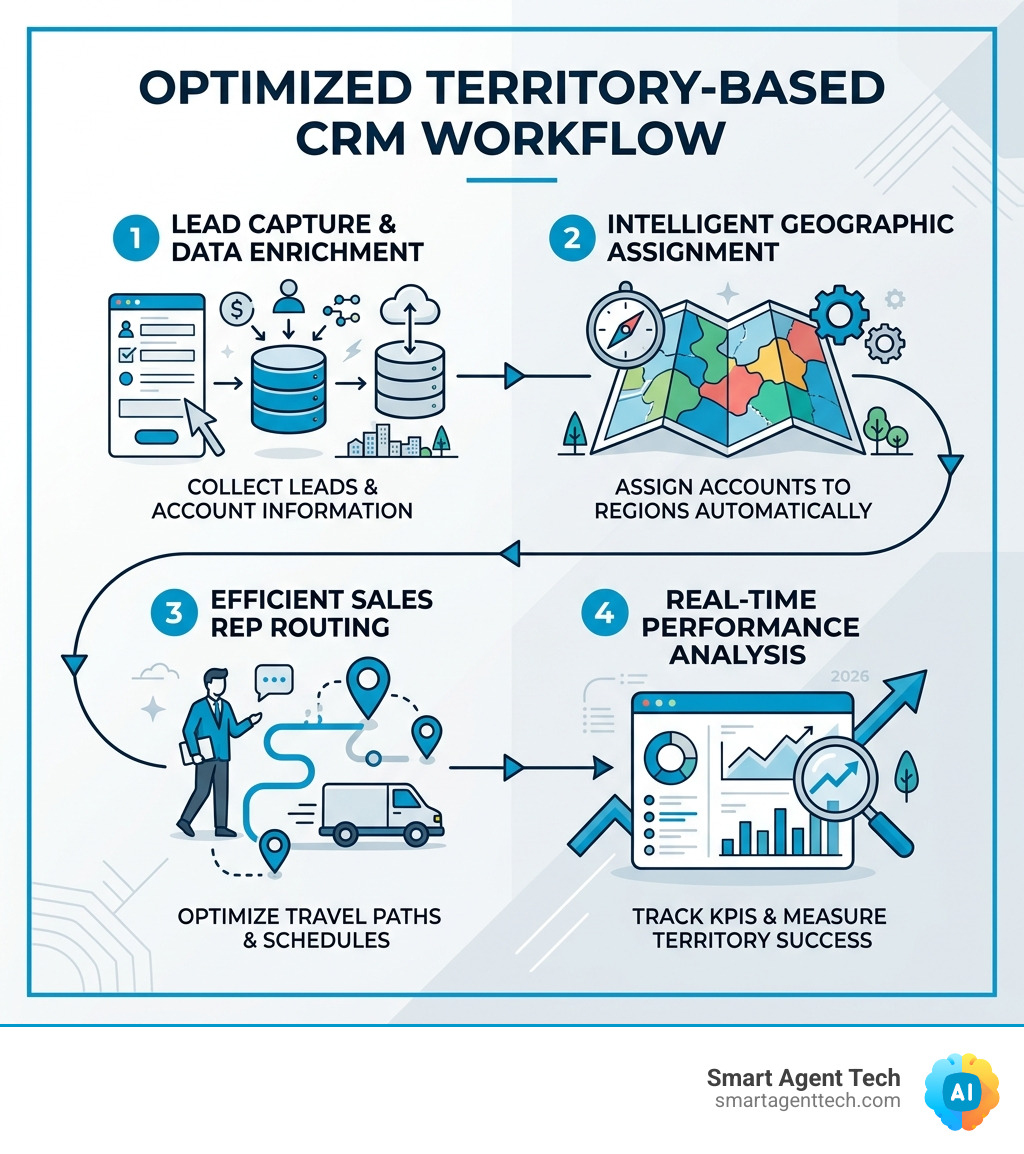
A territory based CRM system is software that organizes your leads, customers, and sales data by defined geographic or demographic regions — then automatically assigns that data to the right rep or team.
When evaluating a system for your team, look for these essential capabilities:
Automated Assignment: Rules that route leads based on ZIP code or city.
Geographic Visualization: Map-based views of your entire pipeline.
Route Optimization: Tools to help field agents minimize drive time.
Hierarchical Structure: The ability to nest ZIP codes within larger counties or regions.
Data Exclusivity: Ensuring reps only see the data relevant to their assigned area.
Managing a sales territory without the right tools is a genuine headache. Most standard CRMs show you a list of names, addresses, and phone numbers — but they won't tell you where those contacts are, who should own them, or whether two reps are chasing the same lead at the same time.
That last problem is more costly than most teams realize. Blurred territory boundaries drive up service costs, create customer confusion, and quietly destroy team morale. When two agents are calling the same prospect, nobody wins.
For real estate agents and brokers, this gets even more complicated. You're juggling new construction leads, resale clients, anonymous website visitors, and hyper-local market knowledge — all at once. Without a clear system for who owns what geography, growth stalls fast.
This guide explores how territory management platforms work so you can find the right fit for your team, your market, and your budget.
I'm Todd Bogert, a Real Estate Website Consultant with over a decade of experience helping agents and brokers implement the right tech stack — including territory based CRM systems — to generate more leads and close more deals. Having worked hands-on with various real estate technology platforms, I know exactly where territory management makes or breaks a real estate operation.
Defining the Territory Based CRM System
At its core, a territory based CRM system is about more than just drawing circles on a map. It represents a fundamental shift in how a business handles its data. Unlike traditional CRMs that treat every lead as a single row in a spreadsheet, territory-based systems operate with record-level access tied to geography or specific demographics.
When we talk about geographic boundaries, we are referring to the ability to organize data into regions like cities, counties, or ZIP codes. For example, a brokerage operating in the West Valley AZ might want to ensure that leads in Buckeye AZ are only visible to the agents who live and work in that specific area.
The system works through a specific regional hierarchy:
Market Segmentation: Dividing the larger market into manageable chunks based on potential.
Record Assignment: Automatically tagging a lead, organization, or deal with a specific territory ID.
User Permissions: Granting access to that data only to the users assigned to that territory.
This differs significantly from standard user permissions. While basic permissions might say "Agent A can see all leads," a territory system says "Agent A can only see leads within the 85326 ZIP code." This level of data visualization allows managers to see exactly where their business is coming from and where the "dead zones" are.
For teams evaluating how these boundaries should be structured, the ZIP Code model is a useful reference point because it illustrates how geographic data can be standardized for routing, reporting, and ownership.
Core Features of High-Performance Territory Management
If you are looking for a quality territory based CRM system, you shouldn't settle for a basic map. You need a suite of tools that turn geographic data into actionable sales activities.
Lead Routing and Round-Robin Distribution
One of the most powerful features is automated lead routing. Instead of a manager manually handing out leads every morning, the CRM uses built-in assignment rules. You can set up a "Round-Robin" system within a specific territory. For instance, if three agents cover Phoenix AZ, the system will cycle new leads among those three agents specifically, ensuring a fair workload.
Mapping and Visualization
You can't manage what you can't see. Top-tier mapping tools allow you to create heatmaps and custom layers. This helps you identify clusters of high-value activity. Visual layers help managers identify where to allocate more resources and where market penetration is lacking.
Mobile Access and Route Optimization
For field sales teams, mobile access is non-negotiable. Advanced field sales tools provide GPS integration and route optimization. This allows an agent in the West Valley to plan their day so they aren't driving back and forth across town. It calculates the most efficient path between appointments, which can significantly reduce travel time and fuel costs.
Accurate Data Foundations
A territory system is only as good as its data. High-performing systems often integrate with comprehensive ZIP code databases. Using data updated from reliable sources ensures that when you assign a territory by postal code, the boundaries are 100% accurate.
Strategic Benefits for Sales Teams and Managers
Why go through the effort of setting up a territory based CRM system? Because the ROI is massive. Research shows that specialized software can accelerate territory design and optimization by up to 32 times compared to manual methods.
Conflict Reduction: When territories are clearly defined, you "Kill Territory Overlap." This eliminates the internal friction caused by two reps calling on the same customer, which boosts morale and prevents wasted resources.
Sales Forecasting: By structuring deals by territory, you can use regional reporting to make forecasting more accurate. You can compare the performance of Buckeye AZ against Phoenix AZ to see which market is truly growing.
Reduced Attrition: Sales reps are more motivated when they have a "fair shot" at their quota. A balanced territory ensures that one rep isn't overwhelmed while another is starving for leads.
Customer Loyalty: Customers receive better service when they have a dedicated local expert who understands their specific regional needs.
Enhancing Real Estate Success with a Territory Based CRM System
In the real estate industry, territory management is the difference between being a "generalist" and ruling a specific market. At Smart Agent Tech, we take this a step further. Our all-in-one platform is designed specifically for the modern agent who needs a competitive edge.
Our unique selling proposition is our New Home Source integration. We provide exclusive, real-time pre-MLS new construction listings. The best part? We offer one agent per territory exclusivity. This means if you claim a territory in Buckeye or Phoenix, you are the only one with access to those specific high-value new build leads through our system.
When you combine a territory based CRM system with our lead capture, AI tools, and cash offer integration, you aren't just managing a region—you're dominating it. We give you the "where" (the territory) and the "what" (exclusive listings) to ensure your pipeline stays full.
Implementation and Scaling Your Geographic Strategy
Setting up your territories requires a strategic approach. You shouldn't just draw lines randomly; you need to base your decisions on empirical data.
Territory Type Definition Best Use Case Geographic Based on ZIP codes, cities, or counties. Local real estate, field sales, deliveries. Demographic Based on household income, age, or business size. High-end luxury real estate, B2B services. Custom Hand-drawn boundaries (Lasso tool). Areas with natural barriers (rivers, highways).
Steps for Effective Setup:
Data Import: Start by cleaning your existing data. Ensure your location data is standardized to avoid mapping errors.
Hierarchy Setup: Define your regions from the top down (State > County > City > ZIP).
Scenario Planning: Use "What-If" modeling. If we add two more agents to the Phoenix AZ team, how should we split the existing territories to keep workloads balanced?
Territory Realignment: Don't set it and forget it. As your team grows or market dynamics shift, you must realign boundaries to avoid under-servicing certain areas.
Overcoming Challenges in a Territory Based CRM System
Implementation isn't always a walk in the park. Common challenges include:
Data Accuracy: If a lead's address is entered incorrectly, the automation fails. This is why regular updates and GPS verification are vital.
User Adoption: Reps might resist being "locked out" of certain areas. You must demonstrate how a more focused territory leads to higher conversion rates and less driving.
Administrative Overhead: Managing complex hierarchies can be time-consuming. Look for systems with drag-and-drop interfaces to make adjustments easy.
Frequently Asked Questions about Territory Management
How does territory management differ from standard user permissions?
Standard permissions are usually "all or nothing" or based on a user's role (Manager vs. Agent). Territory management is record-level. It assigns specific leads to specific territories, and then assigns users to those territories. It is a dynamic system that handles routing and access based on the lead's location, not just the user's job title.
What data is required to set up sales territories effectively?
At a minimum, you need:
Customer Locations: ZIP codes or coordinates.
Historical Performance: Which areas have the highest closing rates?
Rep Capacity: How many leads can one agent realistically handle?
Market Potential: Use demographic data to identify "hidden gem" neighborhoods.
How often should a business realign its territories?
Most experts recommend a formal review at least once a year. However, you should trigger an immediate audit if you experience significant team growth, a major market shift (like a new housing development opening in Buckeye AZ), or if you notice a consistent drop in performance in a specific region.
Conclusion
Ruling your market requires more than just hard work; it requires a strategic, geographic approach to your data. By implementing a territory based CRM system, you eliminate the chaos of overlapping leads, optimize your team's travel time, and provide a level of local expertise that competitors simply can't match.
Whether you are a solo agent looking to own a ZIP code or a large brokerage managing teams across the West Valley, the right mapping and assignment tools are your path to revenue maximization.
Ready to stop guessing and start growing? Rule your market with the Smart Agent Suite and claim your exclusive territory today.
