Click Here for Cash: Top Home Selling Platforms Reviewed
The Fastest Way to Sell Your Home: A Cash Offer Platform Comparison
A cash offer platform connects home sellers with buyers - investors, iBuyers, or marketplace networks - who can purchase your home quickly, often as-is, without the delays of a traditional listing. Here's a quick look at the primary models:
Platform Model Description Availability Typical Close Time Marketplace Multiple offer types from various buyers Nationwide 7-14 days Direct Buyer Direct purchase from the platform Nationwide ~7 days Investor Network Vetted local and national investors Nationwide 2-3 weeks
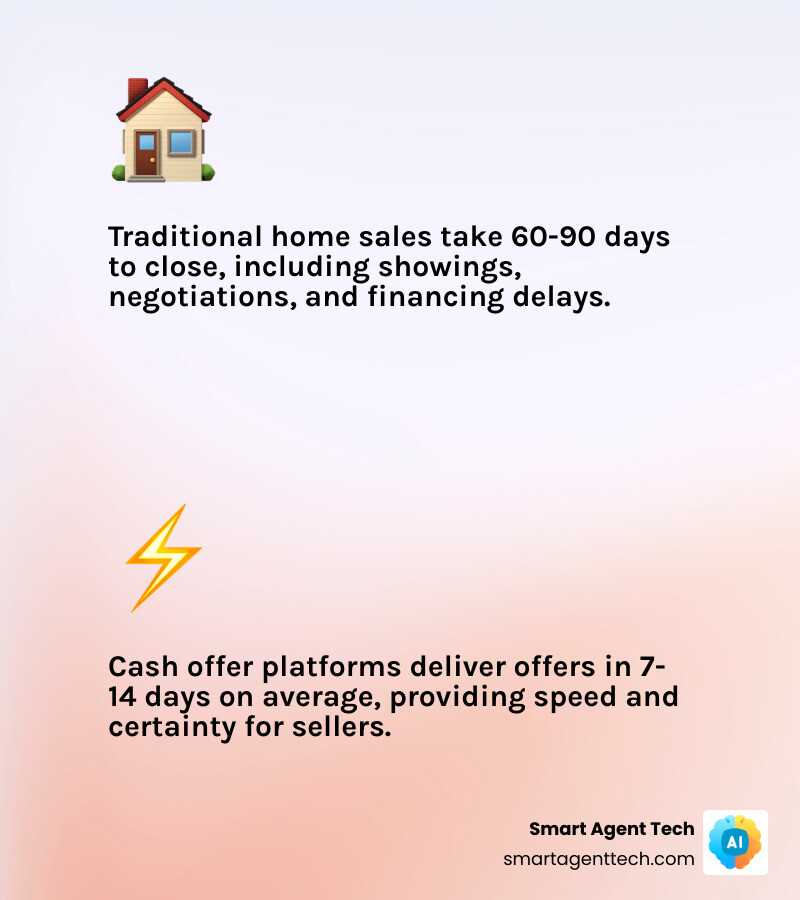
Traditional home sales take 60-90 days to close. Cash offers average 7-14 days. That speed comes with a tradeoff - investors typically offer 65%-70% of a home's after-repair value (ARV), so you're trading top dollar for certainty and convenience.
Not every platform works the same way, and the differences matter - especially when your home or situation doesn't fit the standard mold.
I'm Todd Bogert, a real estate website consultant with over a decade of experience helping agents and brokers generate leads and close deals faster - including helping clients navigate tools like every major cash offer platform on the market. My background in real estate tech gives me a clear-eyed view of what these platforms actually deliver versus what they promise, and I'll walk you through exactly what to look for.
Understanding the Modern Cash Offer Platform
In the old days, if you wanted a cash offer, you usually had to call a number on a "We Buy Houses" sign stapled to a telephone pole. Today, the process has moved into the digital age. A modern cash offer platform acts as a high-tech bridge between homeowners and liquid capital.

Some platforms operate on a direct buying model (often called iBuying), where the company itself buys your home using an algorithm to determine the price. Others use a marketplace model, where they blast your home's details to a vetted network of hundreds of investors who then compete to give you the best price. If you are new to the concept, Wikipedia's overview of real estate investing provides helpful background on how investor-driven purchases work.
The industry has seen massive shifts recently. Several major national real estate tech firms famously exited the direct-buying space in 2021 and 2022. Why? They struggled to accurately forecast home prices during volatile market shifts. This "market exit" trend means that current platforms are more disciplined, often focusing on providing certainty rather than trying to flip thousands of homes at razor-thin margins.
For sellers in areas like Buckeye, AZ, Phoenix, AZ, and the West Valley, this means you have access to platforms that prioritize transaction volume and closing certainty over speculative pricing.
Feature Cash Offer Platform Traditional Listing Speed 7-21 days 60-90+ days Condition As-is (no repairs) Requires repairs/staging Certainty High (no financing contingency) Moderate (deals often fall through) Showings Zero to one Dozens of open houses Net Profit Lower (convenience discount) Higher (market value)
Types of Offers Available to Sellers
Not all cash offers are created equal. Depending on the cash offer platform you choose, the "check" you receive at the end might be calculated very differently.
The housing market has cooled slightly due to higher interest rates, which has pushed many iBuyers to pivot. For example, some large companies saw a 33.5% revenue drop in 2025 compared to 2024, leading them to transition into AI-powered tech platforms that help others facilitate deals rather than buying the homes themselves.
Investor-Backed Cash Offer Platform Options
Most platforms rely on the "70% ARV Rule." This is a standard investor math equation: they take the After-Repair Value (ARV)—what the home would be worth if it were perfectly renovated—and offer about 70% of that, minus the estimated cost of repairs.
The median investor offer typically hovers around 67.5% of the home's value. This is the "as-is" specialist's bread and butter. If you have a distressed property or an inherited home in the West Valley that needs a new roof and a kitchen overhaul, this is often the fastest path to a clean break. These platforms, such as Smart Cash Offers, allow you to skip the "fixer-upper" stress entirely.
Buy-Before-You-Sell and Hybrid Programs
If your home is in good shape but you’re stuck in a "chicken and egg" situation—needing the equity from your current home to buy the next one—you might look at hybrid programs.
Some platforms offer "Bridge" solutions or "7-Day Sold" options. These are designed to give you the speed of a cash buyer with a bit more upside. For instance:
Instant Cash Offers: You get a portion of the equity upfront, and then a second payout after the home is eventually sold on the open market.
Seller Financing: You act as the bank, which can sometimes net you 110-120% of the property value over time through interest payments.
Mortgage Assumption: Allowing a buyer to take over your existing low-interest rate mortgage (if allowed), which can make your home much more attractive in a high-rate environment.
For agents looking to offer these versatile paths to their clients, the Smart Agent Suite provides the tools to manage these complex transaction types seamlessly.
Pros and Cons of Selling to a Cash Buyer
The biggest "pro" is obvious: speed. You can go from "For Sale" to "Money in Bank" in as little as 7 days. You also avoid the "parade of strangers" through your living room. No staging, no cleaning, and—most importantly—no repairs.
However, there are "cons" to consider:
The Convenience Tax: You will almost always walk away with less money than if you listed with an agent and waited for a traditional buyer.
Service Fees: While you save on the traditional 5%-6% agent commission (noting that national averages have shifted slightly following the August 2024 NAR settlement), many iBuyers charge a "service fee" that is often in the same 5%-6% range.
Repair Credits: Even if they buy "as-is," many platforms will conduct an inspection and then ask for a credit off the purchase price to cover the repairs they’ll eventually have to make.
To help balance these pros and cons, our Passive Lead System helps agents identify which sellers are the best fit for cash offers versus those who would be better served by a traditional market listing.
How to Evaluate a Platform for Your Home
Before you sign a contract on a cash offer platform, you need to do your homework. Not every "instant offer" is a firm one.
Always ask for a Proof of Funds. A legitimate platform should be able to show they actually have the liquid cash to close the deal. We also recommend having an attorney or a trusted real estate professional review the contract. Look for "inspection contingencies" that might allow the buyer to back out or drastically lower the price at the last minute.
Comparing Multiple Bids on a Cash Offer Platform
The best way to ensure you aren't leaving too much money on the table is to use a marketplace model. When 500+ vetted investors are competing for your property, the price naturally moves higher.
Check Ratings: Look for platforms with high weighted average customer ratings (some top-tier services boast 4.9 stars across thousands of reviews).
Transparency: Does the platform clearly list their fees?
Local Expertise: Does the buyer actually know the Phoenix or Buckeye market, or are they a national firm using a generic spreadsheet?
Requirements for As-Is Property Sales
While most cash buyers claim to buy "any house," they do have preferences.
iBuyers usually want homes built after 1930, valued between $100k and $600k, and in "fair-to-good" condition.
Local Investors are more likely to take on the "scary" stuff: foundation issues, unpermitted additions, structural problems, or homes facing foreclosure.
Inherited Properties: These are a perfect fit for cash platforms because they often need significant "as-is" clearing and repairs that the heirs don't want to manage.
Frequently Asked Questions about Cash Offers
Do cash platforms pay fair market value?
Generally, no. You are selling your home at a wholesale price. However, when you factor in the 6% commission you aren't paying, the 2-3% in closing costs the buyer often covers, and the thousands you didn't spend on a new roof or carpet, the "net proceeds" can be surprisingly close to a traditional sale for certain homes.
How quickly can I close with a cash buyer?
The average is 7 to 14 days. The record is often around 72 hours, but that requires a very clean title. Most platforms offer "flexible move-out" dates, meaning you can get your cash but stay in the house for an extra week or two while you pack.
Are there hidden fees in cash transactions?
The most common "hidden" cost is the repair deduction. The initial offer might look great, but after the 90-second inspection, they might subtract $15,000 for "deferred maintenance." Always ask if the offer is "firm" or "subject to inspection."
Conclusion
The rise of the cash offer platform has forever changed how we think about real estate in Arizona. Whether you're in Buckeye, Phoenix, or the West Valley, you no longer have to wait months for a qualified buyer to show up.
At Smart Agent Tech, we empower real estate professionals to stay ahead of these trends. Our all-in-one platform includes a robust CRM, AI-powered lead capture, and a unique New Home Source integration that gives you exclusive access to pre-MLS new construction listings—a massive advantage in the fast-moving AZ market.
Ready to bridge the gap between traditional service and modern speed? Get started with a modern cash offer platform today and see how we can help you or your clients move faster.
