
The best AI CRM tools for modern agents
Why Every Real Estate Agent Is Talking About CRM AI Real Estate Tools Right Now
CRM AI real estate platforms are the fastest-growing category in real estate tech - and for good reason. The most effective systems now offer relationship intelligence, automated lead capture from dozens of sources, AI writing assistants, and predictive lead scoring to help agents stay ahead.
Real estate agents today are drowning in apps. There's one tool for leads, another for email, another for transactions - and somehow none of them talk to each other. Meanwhile, hot leads go cold because follow-up is slow, past clients get forgotten, and hours vanish into manual data entry.
AI-powered CRMs are changing that picture entirely.
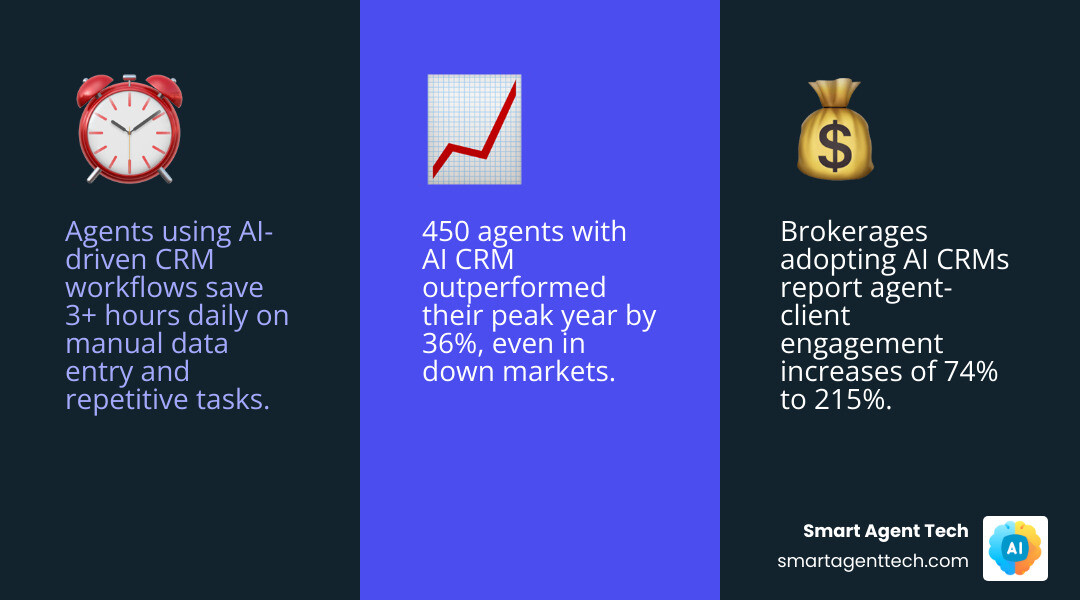
Instead of just storing contacts, today's AI CRMs actively work for you. They score leads, write follow-up messages, flag dormant clients who are ready to move, and automate the repetitive tasks that eat your day. One metric that keeps coming up in the research: agents using AI-driven CRM workflows report saving 3+ hours every single day.
The shift isn't subtle. Brokerages that have adopted these tools report agent-client engagement jumping by as much as 74% to 215% - and in one documented case, 450 agents using an AI CRM outperformed their own peak year by 36%, even in a down market.
This isn't about replacing the human side of real estate. It's about removing the friction so agents can spend more time on what actually closes deals: real conversations with real people.
I'm Todd Bogert, a Real Estate Website Consultant with over a decade of experience helping agents and brokers build high-performance digital systems - including hands-on work across the leading CRM AI real estate platforms in the market today. My technical background and real estate focus give me a practical, no-hype perspective on what these tools actually deliver.
Below, I'll break down the best AI CRMs for modern agents - what they do, how they compare, and which one fits your situation.
Why crm ai real estate is the future of brokerage growth
In the competitive markets of Phoenix, Buckeye, and the West Valley, staying ahead of the curve isn't just a goal—it's a survival tactic. Traditional CRMs act like digital filing cabinets; they hold information, but they don't tell you what to do with it. CRM AI real estate technology turns that filing cabinet into a proactive digital partner.
The core of this transformation lies in predictive analytics and lead scoring. Instead of an agent scrolling through a list of 500 names wondering who to call, the AI analyzes behavioral triggers—like a past client suddenly checking local property values or a new lead visiting a listing three times in 24 hours. It then flags these "hidden opportunities," ensuring agents focus their energy where a deal is most likely to happen.
Research shows that implementing these intelligent systems can lead to a 36% sales production boost. This isn't just about finding new leads; it's about mining the "relationship gold" already sitting in your sphere of influence. For brokerages in Arizona, where the market can shift rapidly, having a tool that automatically identifies who is ready to buy or sell can be the difference between a record-breaking year and a stagnant one.
Furthermore, these platforms help with network amplification. By automating the "busy work"—logging calls, syncing emails, and updating contact info—agents are freed up to engage in more high-value activities. When the AI handles the administrative heavy lifting, agent engagement with clients has been shown to increase significantly, sometimes doubling or tripling.

More info about marketing tools
Maximizing ROI with crm ai real estate
Profitability in real estate is often a game of "attach rates" and "conversion speeds." AI CRMs accelerate profitability by ensuring no lead is left behind. When a system can automatically capture leads from over 15 different sources and immediately enroll them in a personalized follow-up plan, the "leakage" in the sales funnel disappears.
We’ve seen results where mortgage capture rates increased to 70% simply because the AI prompted the right conversation at the exactly right moment. This level of automated nurturing means that even if an agent is busy at a showing in Buckeye, the AI is still working in the background, answering initial inquiries and qualifying prospects.
The ROI of crm ai real estate isn't just measured in closed deals; it's measured in agent retention and engagement. Agents love tools that make their lives easier. When a brokerage provides a platform that reduces data entry and provides a clear daily "to-do" list based on actual opportunities, agent adoption skyrockets. High adoption leads to better data, which leads to better forecasting and, ultimately, a more profitable business.
Essential integrations for crm ai real estate
An AI CRM is only as good as the data it can access. For agents in the Phoenix metro area, MLS sync is the non-negotiable foundation. Top-tier platforms pull real-time property data directly into the CRM, allowing AI to match leads with new listings the second they hit the market.
Beyond the MLS, integration with popular listing portals like Zillow and Realtor.com ensures that every inquiry is captured instantly. However, the real magic happens when you connect these systems to broader tools via platforms like Zapier. This allows for custom workflows—for example, automatically sending a thank-you note via a third-party app the moment a deal moves to the "pending" stage.
Essential integrations should also cover:
Communication Channels: Syncing Gmail, Outlook, and even WhatsApp so every conversation is logged without manual input.
Transaction Management: Connecting with tools like DocuSign to ensure compliance and smooth transitions from "lead" to "closed."
Marketing Automation: Linking with email and social media tools to maintain a consistent brand presence across all platforms.
More info about passive lead systems
Key features of high-performing AI real estate platforms
When evaluating crm ai real estate software, you shouldn't just look for "AI" as a buzzword. You need specific features that solve real-world problems. One of the most impactful features is the AI writing assistant. We know that 93% of Realtors prefer texting their clients because of its high response rate. An AI assistant can draft these texts, as well as emails and property descriptions, in seconds. This ensures the tone is professional and the follow-up is immediate.
Another critical feature is automated lead routing. Instead of manually assigning leads, the AI can route them based on the agent's specialty, current workload, or even the lead's specific location (like West Valley vs. Phoenix). This ensures the most qualified person handles the inquiry right away.
Behavioral triggers are also a game-changer. If a lead who hasn't spoken to you in six months suddenly starts looking at luxury listings on your site, the AI doesn't just record it—it notifies you to reach out. This "just-in-time" communication is what separates top producers from the rest of the pack.
Feature Manual Management AI-Driven Automation Data Entry Hours spent logging calls/emails Automatic syncing and logging Follow-up Often delayed or forgotten Instant, personalized responses Lead Scoring Guesswork based on intuition Data-backed priority rankings Content Writing from scratch every time Instant AI-generated drafts Availability Limited to business hours 24/7 intelligent engagement
How AI boosts agent productivity and sales performance
The ultimate goal of any crm ai real estate tool is to make agents more effective. By handling the "prep work" - such as summarizing previous interactions, preparing meeting notes, and filtering out low-quality inquiries - AI allows agents to walk into every conversation fully informed. This leads to 30% higher-quality calls because the agent isn't fishing for information; they are providing value.
Many modern platforms now offer 24/7 virtual assistants. These AI "teammates" can handle end-to-end workflows, such as booking appointments or managing social media posts. Imagine an AI agent that handles your initial lead qualification at 2:00 AM on a Sunday, so you wake up on Monday morning with a scheduled showing in Phoenix already on your calendar.
This level of automation doesn't just save time; it reduces the "mental load" of real estate. Agents no longer have to feel guilty about the "ones that got away" because the AI ensures no one falls through the cracks. Whether it's a "Happy Home Anniversary" text or a notification that a past client might be ready to upsell, the AI acts as a second brain that never sleeps.
More info about agent websites
Successfully piloting and implementing an AI CRM
Switching to a new system can be daunting, but a structured 30-day pilot plan can make the transition seamless. The key is to start small.
Data Cleaning: Before you even turn on the AI, clean your existing database. Remove duplicates and ensure contact info is up to date.
Define Success Metrics: What are you trying to improve? Is it response time, lead conversion, or simply saving time on data entry?
Train a Core Group: Start with a few "tech-forward" agents who can provide feedback and act as champions for the new system.
Mobile-First Adoption: Ensure everyone has the app on their phone. AI works best when it's in your pocket, logging calls and texts as they happen in the field.
During the pilot, monitor the AI-driven outputs daily. Are the lead scores accurate? Is the automated routing working as intended? By refining the setup in the first month, you set the stage for long-term ROI and high team adoption.
More info about the smart agent suite
Frequently Asked Questions about AI CRMs
Does an AI CRM replace the personal relationship between agent and client?
Absolutely not. In fact, it does the opposite. By automating the repetitive administrative tasks, AI gives you more time to focus on the human side of the business. It "tees up" the conversation so you can step in at the most critical moments to provide expert advice and build trust.
How does AI lead scoring help prioritize daily follow-ups?
AI lead scoring looks at hundreds of data points—website visits, email opens, property saves, and even external market data—to rank your leads. Instead of calling through an alphabetical list, your CRM gives you a "Daily Agenda" of the people most likely to take action today. This ensures you spend your time where it matters most.
Can AI CRMs integrate with local MLS feeds and property portals?
Yes, this is a standard feature for high-quality crm ai real estate platforms. They connect directly to MLS feeds to ensure property data is accurate and up-to-date. They also integrate with major portals like Zillow and Realtor.com to pull in new leads instantly, ensuring you are the first to respond.
Conclusion
The era of the "dumb" CRM is over. For agents and brokerages in Phoenix, Buckeye, and the West Valley, adopting crm ai real estate tools is no longer optional—it's the new standard for excellence. These platforms provide the efficiency, insights, and automation needed to thrive in a market.
At Smart Agent Tech, we take this a step further. We provide an all-in-one platform that combines these powerful AI tools with something truly exclusive: New Home Source integration. This gives our agents access to real-time, pre-MLS new construction listings that aren't available on standard portals. With our "one agent per territory" model, you can secure exclusive rights to these high-value leads in your specific area.
Whether you're looking to automate your follow-up, uncover hidden opportunities in your sphere, or dominate the new construction market in Arizona, the right AI-powered CRM is your path to higher production and less stress.
